


Pedicled trapezius musculocutaneous flap in the reconstruction of a shoulder defect after the resection of soft tissue sarcoma – case report and literature review
- Institute for Orthopedic Surgery “Banjica”, Belgrade, Serbia
- University of Belgrade, Faculty of Medicine, Belgrade, Serbia
ABSTRACT
Introduction: Soft tissue sarcomas (STS) in the extremities require complex treatment involving limb-sparing surgery with adjuvant therapy. The treatment involves tumor resection with wide margins along with additional radiation and/ or chemotherapy. In addition to tumor resection, an important aspect is the reconstruction of the resulting soft tissue defect. For extensive reconstructive procedures in the upper extremities, literature suggests the use of free or pedicled flaps. In the shoulder region, due to its complex regional anatomy, selecting an appropriate flap is the surgical imperative. Recently, there has been significant interest in the use of the pedicled trapezius musculocutaneous flap, which offers certain advantages over other flaps.
Case report: A female patient (31 years old) with STS in the left shoulder region, was surgically treated three times. The first surgery involved an intralesional procedure – R2 resection when a pleomorphic dermal sarcoma was diagnosed. After five months, a recurrence of the disease was detected based on magnetic resonance imaging (MRI) findings at the site of the surgical scar. Tumor resection was performed, and the soft tissue defect was covered with a free Thiersch partial-thickness skin graft. Histopathological analysis revealed a high-grade leiomyosarcoma. Two months after the second surgery, MRI findings confirmed a recurrence of the disease. Wide tumor resection was conducted, and the soft tissue defect was covered with a pedicled lower trapezius musculocutaneous flap.
Conclusion: The literature lacks studies describing the outcomes of the use of trapezius flaps in the reconstruction of defects in the shoulder region following STS resection. Additionally, there is no unanimous official opinion on the resection margin width that is considered safe. The treatment outcome of our patient indicates the significant potential and advantages of the trapezius flap, as compared to other flaps of that region.
INTRODUCTION
Soft tissue sarcomas (STS) are a heterogeneous group of tumors and account for about 1% of all tumors in adults, and as many as up to 15% of tumors in children aged four years and younger [1],[2]. In Europe, the total incidence for all localizations is 4 - 5/100,000, annually [3],[4]. In adults, 60% of these tumors are localized in the extremities, of which 45% in the legs and 15% in the arms [5]. When the tumor is in the arm, in about 50% of the cases it is localized in the shoulder region, in 30% - 40% of the cases it is in the region of the elbow and forearm, and in 10% - 20% of the cases it can be found in the hand [6],[7].
The modern standard in STS treatment involves limb-sparing surgery, which is achieved by tumor resection with the widest possible margins, with additional adjuvant radiation and/or chemotherapy. This therapeutic approach shows good results, considering that the application of this protocol can avoid amputation in about 95% of cases [8],[9],[10].
In some cases, the attempt to achieve good resection margins leaves significant defects that require extensive reconstructive procedures. Appropriate reconstruction of these defects is of invaluable clinical importance because it provides the possibility of quickly applying adjuvant oncological therapy and thus establishing better local and systemic control of the disease. Literature suggests that, in this sense, the approaches that use free and pedicled musculocutaneous flaps are the most effective, especially when it comes to the arm [8],[11].
Free musculocutaneous flaps taken from a distant donor site are the best choice for the reconstruction of large defects. The disadvantage of these flaps is that they are technically complicated to harvest and transplant, they require a longer surgical procedure, as well as microsurgical experience, at the same time carrying a risk of failure [11],[12],[13].
Due to the complex anatomy of the shoulder region, the best alternative is the use of vascular pedicled flaps, both local and distant. Local flaps with a vascular pedicle are technically less challenging but are limited in size and are not sufficient to cover larger defects. The best choice for defects in this particular region is the use of distant vascular flaps. Their main advantages are reliability and universality, a simpler surgical technique compared to free flaps, as well as the possibility of faster postoperative recovery [14].
When it comes to defects in the shoulder girdle, musculocutaneous flaps based on the latissimus dorsi muscle and the pectoralis major muscle are most commonly used, although in recent years there has been an increased interest in the use of the pedicled trapezius musculocutaneous flap [12]. There are few studies describing the results of the application of this flap in the reconstruction of defects in the shoulder region after STS resection.
This paper will present a case of a recurrence of STS in the shoulder girdle with the application of wide resection and reconstruction of the tissue defect using a distant pedicled trapezius musculocutaneous flap. Also, oncological and functional treatment results will be presented, with an additional review of the available literature.
PATIENT CASE REPORT
We present a 31-year-old female patient who was surgically treated three times for STS in the region of the left shoulder. An intralesional procedure – R2 resection was performed for the first time, wherein pathohistological analysis confirmed a pleomorphic dermal sarcoma.
Five months after the first procedure, upon clinical examination, a soft tissue lesion was found in the area of the surgical scar, corresponding to a “rest” recurrence of the tumor, which was confirmed with nuclear magnetic resonance imaging (NMRI). Resection of the tumor was planned and performed, which included the skin, subcutaneous tissue, and part of the muscle in the left shoulder area. For the reconstruction of the soft tissue defect, a free Thiersch partial-thickness skin graft was used. In the following weeks, the free skin graft healed completely. The patient had no subjective complaints in the form of pain and had full movement in the left shoulder. The pathohistological findings confirmed high-grade leiomyosarcoma, with the resection line three millimeters away from the tumor mass. A decision was made to perform local radiation therapy on the patient.
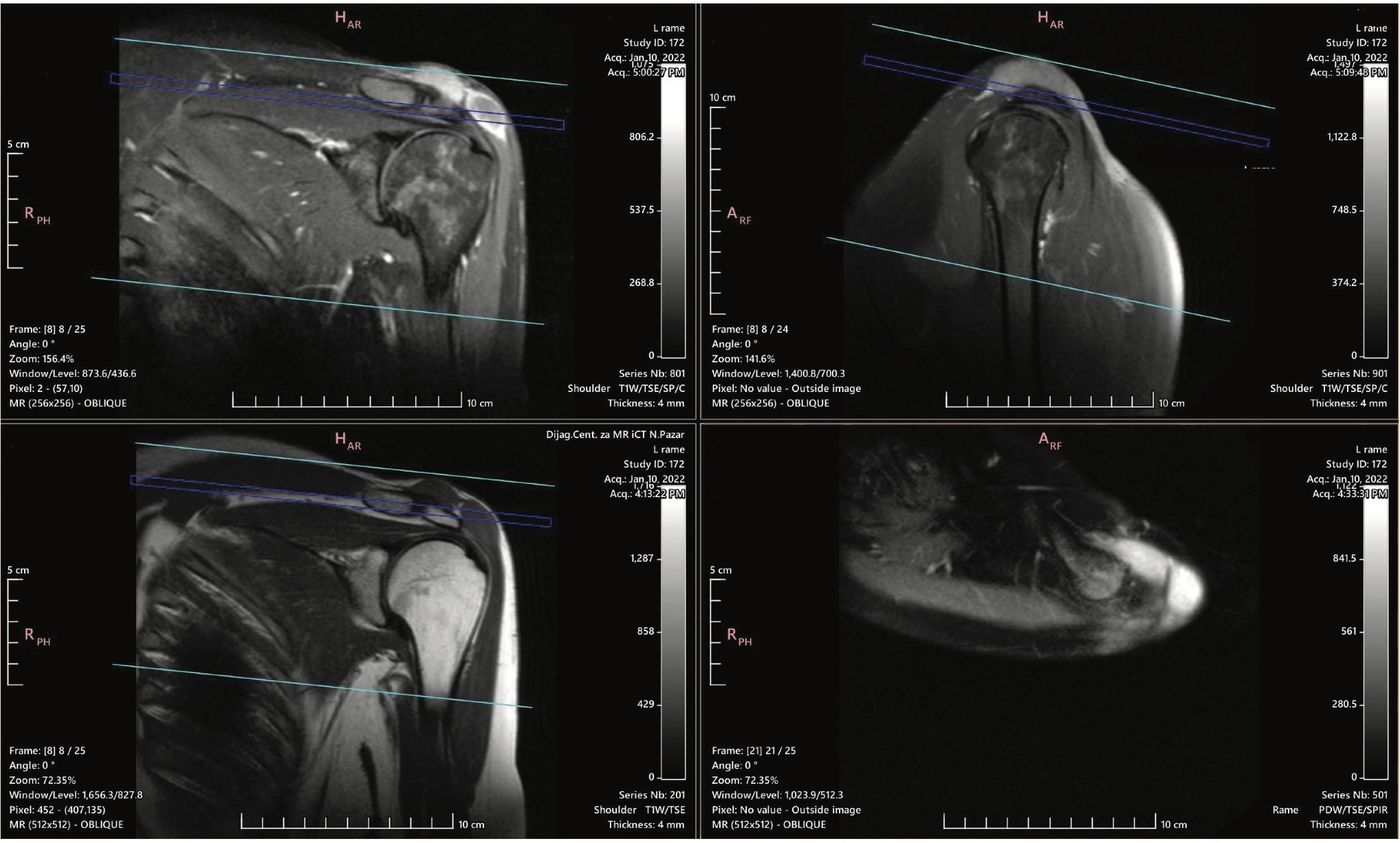
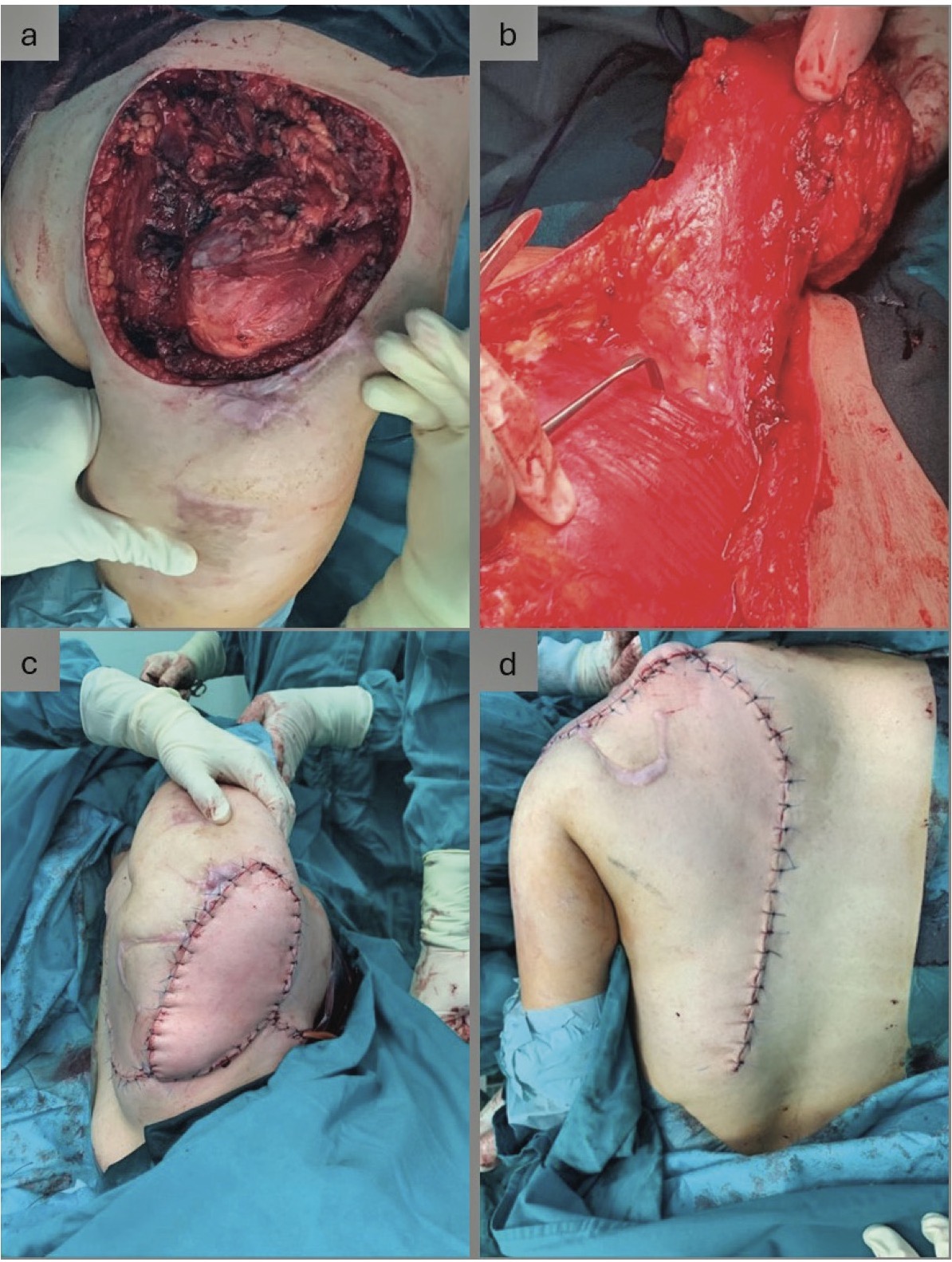
Two months after the operation, follow-up NMRI showed a recurrence of the tumor (Figure 1), and a new surgical procedure was indicated. A wide resection of the tumor was planned and performed. On this occasion, the resection margins were about 30 mm from the tumor margins on the skin and 20 mm from the tumor margins in the underlying deep structures The resection included the skin, subcutaneous tissue, part of the deltoid muscle, and part of the lateral clavicle (Figure 2 a-b). The resulting soft tissue defect after resection (Figure 2 c-d) was covered with a pedicled trapezius musculocutaneous flap. Chemotherapy in the form of three cycles of Mono ADM (Adriablastin 75 mg/m2 ) was performed as adjuvant therapy, followed by local radiation therapy.
DISCUSSION AND TREATMENT RESULTS
STS in the arm, especially in the shoulder region, represents a great challenge in surgical treatment, given the complex anatomy of this region. In earlier medical practice, these patients were, in a large number of cases, treated by limb amputation. The development of new and sophisticated diagnostic methods, the advancement of surgical techniques, and the formulation of new protocols for adjuvant therapy have enabled, in most cases, the preservation of limbs [15],[16].
The treatment of patients with STS of the shoulder is multidisciplinary and requires individual therapeutic algorithms for each patient. The initial part of that protocol is the resection of the tumor with appropriate wide margins. In the last few decades, there has been a tendency to narrow the resection margins, however, scientific controversy about their exact width remains ongoing [17],[18],[19].
Current scientific literature not only lacks specific guidelines for the width of resection margins but also lacks a standard definition of negative margins in STS resection [19]. Although most published case series conclude that the resection of STS with positive margins is accompanied by an unacceptably high rate of local recurrence [20],[21],[22],[23], several studies have shown that a positive resection margin does not affect the rate of local disease recurrence [24],[25].
King et al. demonstrated that the incidence of local recurrence was similar whether the width of the resection margins was less than 1 mm or greater than 1 mm [26]. This finding contrasts with the study by Dickinson et al., which showed that positive margins or margins of less than 1 mm are completely inadequate, but that there is no significant difference if the margins are in the range between 1 mm and 4 mm, 5 mm and 9 mm, or 10 mm and 19 mm [27]. On the other hand, a significant number of studies have stressed the need for resection margins wider than 1 mm [19]. Some authors state that the minimum acceptable negative margin of resection must not be less than 2 mm [28],[29]. Numerous studies support the position that negative resection margins should be at least 5 mm wide, if the treatment plan does not include adjuvant radiotherapy, while, if such therapy is planned, they can be decreased to 1 mm [18],[30]. Given that achieving appropriate resection margins can be extremely challenging, a microscopic distance from the tumor of 1 mm is considered satisfactory, while operative resection margins are set much wider, i.e., at 20 to 30 mm [31],[32].
The possibility of soft tissue reconstruction leaves room for achieving a “safe” wide resection. To completely remove the tumor, it is sometimes necessary to cause relatively large damage to the surrounding tissue structures, which can leave functional and aesthetic defects. This is why the reconstruction of soft tissues is of great importance as it enables wider tumor resection, thereby achieving better local disease control and treatment results.
During the second surgical procedure performed on the patient presented in this case report, resection was carried out, which resulted in three-millimeter margins. On that occasion, the resection site was covered with a Tirsch graft, and predominantly secondary intention healing occurred, which is a slow process that caused the time limit for radiation therapy to be broken. In the meantime, a recurrence occurred, which indicated the application of radical surgery, so wide resection was performed, resulting in a large soft tissue defect that was covered by a pedicled trapezius musculocutaneous flap. Despite the application of radical surgery, a resection margin of 1 mm was achieved, and the use of this graft enabled rapid healing, which made room for the timely application of chemotherapy, and then targeted local radiation therapy, at the resection site.
Large tissue defects after STS resection require immediate reconstruction to close the wound and restore anatomical function, thus facilitating rehabilitation and enabling timely application of adjuvant therapeutic protocols [17]. When it comes to the particular location of STS in the shoulder region, these defects must be closed with a durable flap that will not limit movement in the joint [33]. One of the most suitableflaps for the reconstruction of medium to large defects in the shoulder region is the distant pedicled trapezius musculocutaneous flap. The composite trapezius flap was first described and popularized by Demergass in 1979 [34]. The most important advantages of this flap are its accessibility, easy harvesting, good vascularization, relatively small thickness, and the possibility of obtaining the desired shape and size. Its main disadvantage is the variability of vascularization and rather difficult identification of the main blood vessels for blood supply. Due to these disadvantages, this flap is classified as class II and is therefore rarely used in clinical practice [35].
Bearing in mind that the tissue defect after STS resection in the patient presented in this case study was in the back of the shoulder, the lower trapezius musculocutaneous flap was selected for reconstruction. One of the most significant advantages of using the trapezius flap is the preservation of the latissimus dorsi muscle, whose displacement leaves a larger defect in the muscle mass with worse aesthetic results and potentially significant functional damage. On the other hand, the trapezius muscle is smaller but can be transplanted with a significant skin flap leaving a smaller defect at the donor site while allowing greater freedom in soft tissue coverage. The advantage of using this flap in preserving the latissimus dorsi muscle for potential subsequent surgical procedures, in case of local recurrence of the disease, is also not negligible.
The abovementioned advantages of using this particular flap have been confirmed in the current treatment outcome of the patient presented in this case report. During two years after the described surgical treatment, the patient was regularly monitored with NMRI of the surgically treated region, and with CT scans of the lungs, abdomen, and pelvis, wherein neither local recurrence nor secondary deposits were detected. At the functional level, the patient has full range of motion, and no neurological symptoms or painful sensations. From an aesthetic point of view, the scar is satisfactory.
All of the above leads to the conclusion that the trapezius muscle is almost ideal for covering defects in the shoulder, because the muscle itself is relatively small, and it carries with it a significant skin covering that is sufficient to close medium and even some larger defects. In addition, the latissimus dorsi muscle is spared, which is a larger muscle whose transposition results in an aesthetic defect and potential functional limitation, and which could be used in case of recurrence and the need for re-resection.
Informations

-
Keywords:
-
Received:
-
Revised:
-
Accepted:
-
Online first:
-
DOI:
-
Cite this article:

Bojan Petrović
Institute for Orthopedic Surgery “Banjica”
28 Mihaila Avramovića Street, 11000 Belgrade, Serbia
E-mail:
1. Fenzl L, Mehrmann M, Kremp K, Schneider G. Weichteiltumoren: Epidemiologie, Klassifikation und Stadieneinteilung. Radiol. 2017;57(11):973-986. doi:10.1007/s00117-017-0320-1. [CROSSREF]
2. Toro JR, Travis LB, Wu HJ, Zhu K, Fletcher CDM, Devesa SS. Incidence patterns of soft tissue sarcomas, regardless of primary site, in the surveillance, epidemiology and end results program, 1978–2001: An analysis of 26,758 cases. Int J Cancer. 2006;119(12):2922-2930. doi:10.1002/ijc.22239. [CROSSREF]
3. Casali PG, Abecassis N, Aro HT, Bauer S, Biagini R, Bielack S, et al; ESMO Guidelines Committee and EURACAN. Soft tissue and visceral sarcomas: ESMO-EURACAN Clinical Practice Guidelines for diagnosis, treatment and follow-up. Ann Oncol. 2018 Oct 1;29(Suppl 4):iv51-iv67. doi: 10.1093/annonc/mdy096. [CROSSREF]
4. Stiller CA, Trama A, Serraino D, Rossi S, Navarro C, Chirlaque MD, et al; RARECARE Working Group. Descriptive epidemiology of sarcomas in Europe: report from the RARECARE project. Eur J Cancer. 2013 Feb;49(3):684-95. doi: 10.1016/j.ejca.2012.09.011. [CROSSREF]
5. Lahat G, Lazar A, Lev D. Sarcoma Epidemiology and Etiology: Potential environmental and genetic factors. Surg Clin North Am. 2008;88(3):451-481. doi:10.1016/j.suc.2008.03.006. [CROSSREF]
6. Gustafson P, Arner M. Soft tissue sarcoma of the upper extremity: descriptive data and outcome in a population-based series of 108 adult patients. J Hand Surg. 1999;24(4):668-674. doi:10.1053/jhsu.1999.0668. [CROSSREF]
7. Gerrand CH, Wunder JS, Kandel RA, O’Sullivan B, Catton CN, Bell RS, et al. The influence of anatomic location on functional outcome in lower-extremity soft-tissue sarcoma. Ann Surg Oncol. 2004 May;11(5):476-82. doi: 10.1245/ ASO.2004.07.016. [CROSSREF]
8. Lucattelli E, Lusetti IL, Cipriani F, Innocenti A, De Santis G, Innocenti M. Reconstruction of upper limb soft-tissue defects after sarcoma resection with free flaps: A systematic review. J Plast Reconstr Aesthet Surg. 2021;74(4):755- 767. doi:10.1016/j.bjps.2020.10.065. [CROSSREF]
9. Smith HG, Thomas JM, Smith MJF, Hayes AJ, Strauss DC. Major amputations for extremity soft-tissue sarcoma. Ann Surg Oncol. 2018;25(2):387-393. doi:10.1245/s10434-017-5895-2. [CROSSREF]
10. Duran-Moreno J, Kontogeorgakos V, Koumarianou A. Soft tissue sarcomas of the upper extremities: Maximizing treatment opportunities and outcomes. Oncol Lett. 2019;18(3):2179-2191. doi:10.3892/ol.2019.10575. [CROSSREF]
11. Krijgh DD, Mureau MAM. Reconstructive options in patients with late complications after surgery and radiotherapy for head and neck cancer: remember the deltopectoral flap. Ann Plast Surg. 2013;71(2):181-185. doi:10.1097/ SAP.0b013e3182414612. [CROSSREF]
12. Can A, Orgill DP, Dietmar Ulrich JO, Mureau MAM. The myocutaneous trapezius flap revisited: A treatment algorithm for optimal surgical outcomes based on 43 flap reconstructions. J Plast Reconstr Aesthet Surg. 2014;67(12):1669- 1679. doi:10.1016/j.bjps.2014.07.044. [CROSSREF]
13. Naalla R, Murthy V, Chauhan S, Chinta K, Singhal M. Revisiting the trapezius flap as a reconstructive option for cervico-occipital and thoracic spine regions. Indian J Plast Surg. 2019;52(03):322-323. doi:10.1055/s-0039-3400677. [CROSSREF]
14. Benanti E, De Santis G, Leti Acciaro A, Colzani G, Baccarani A, Starnoni M. Soft tissue coverage of the upper limb: A flap reconstruction overview. Ann Med Surg. 2020;60:338-343. doi:10.1016/j.amsu.2020.10.069. [CROSSREF]
15. Brennan MF, Casper ES, Harrison LB, Shiu MH, Gaynor J, Hajdu SI. The role of multimodality therapy in soft-tissue sarcoma: Ann Surg. 1991;214(3):328- 338. doi:10.1097/00000658-199109000-00015. [CROSSREF]
16. Nichter L, Menendez L. Reconstructive considerations for limb salvage surgery. Orthop Clin North Am. 1993;24(3):511-521.
17. Koulaxouzidis G, Simunovic F, Bannasch H. Soft tissue sarcomas of the arm – oncosurgical and reconstructive principles within a multimodal, interdisciplinary setting. Front Surg. 2016;3. [Internet]. [Pristupljeno: 14. oktobar, 2022.]. Dostupno: [CROSSREF]
18. Cates MM, Cates JMM. Surgical resection margin classifications for high-grade pleomorphic soft tissue sarcomas of the extremity or trunk: definitions of adequate resection margins and recommendations for sampling margins from primary resection specimens. Mod Pathol. 2019;32(10):1421-1433. doi:10.1038/s41379-019-0278-9. [CROSSREF]
19. Sambri A, Caldari E, Fiore M, Zucchini R, Giannini C, Pirini MG, et al. Margin Assessment in Soft Tissue Sarcomas: Review of the Literature. Cancers (Basel). 2021 Apr 2;13(7):1687. doi: 10.3390/cancers13071687. [CROSSREF]
20. Bilgeri A, Klein A, Lindner LH, Nachbichler S, Knösel T, Birkenmaier C, et al. The Effect of Resection Margin on Local Recurrence and Survival in High Grade Soft Tissue Sarcoma of the Extremities: How Far Is Far Enough? Cancers (Basel). 2020 Sep 8;12(9):2560. doi: 10.3390/cancers12092560. [CROSSREF]
21. Kawaguchi N, Ahmed AR, Matsumoto S, Manabe J, Matsushita Y. The concept of curative margin in surgery for bone and soft tissue sarcoma: Clin Orthop. 2004;419:165-172. doi:10.1097/00003086-200402000-00027. [CROSSREF]
22. Vodanovich DA, Spelman T, May D, Slavin J, Choong PFM. Predicting the prognosis of undifferentiated pleomorphic soft tissue sarcoma: a 20‐year experience of 266 cases. ANZ J Surg. 2019;89(9):1045-1050. doi:10.1111/ans.15348. [CROSSREF]
23. Chen Y, Hao J, Yang Y, Yang J, Hao X. Tumor rupture predicts early metastasis and poor prognosis in stage III soft tissue sarcomas. World J Surg. 2011;35(5):1002-1009. doi:10.1007/s00268-011-0995-9. [CROSSREF]
24. Kamat NV, Million L, Yao DH, Donaldson SS, Mohler DG, van de Rijn M, et al. The Outcome of Patients With Localized Undifferentiated Pleomorphic Sarcoma of the Lower Extremity Treated at Stanford University. Am J Clin Oncol. 2019 Feb;42(2):166-171. doi: 10.1097/COC.0000000000000496. [CROSSREF]
25. Kim YB, Shin KH, Seong J, Roh JK, Kim GE, Hahn SB, et al. Clinical significance of margin status in postoperative radiotherapy for extremity and truncal soft-tissue sarcoma. Int J Radiat Oncol Biol Phys. 2008 Jan 1;70(1):139-44. doi: 10.1016/j.ijrobp.2007.05.067. [CROSSREF]
26. King DM, Hackbarth DA, Kirkpatrick A. Extremity soft tissue sarcoma resections: How wide do you need to be? Clin Orthop. 2012;470(3):692-699. doi:10.1007/s11999-011-2167-5. [CROSSREF]
27. Dickinson IC, Whitwell DJ, Battistuta D, Thompson B, Strobel N, Duggal A, et al. Surgical margin and its influence on survival in soft tissue sarcoma. ANZ J Surg. 2006 Mar;76(3):104-9. doi: 10.1111/j.1445-2197.2006.03615.x. [CROSSREF]
28. Novais EN, Demiralp B, Alderete J, Larson MC, Rose PS, Sim FH. Do surgical margin and local recurrence influence survival in soft tissue sarcomas? Clin Orthop. 2010;468(11):3003-3011. doi:10.1007/s11999-010-1471-9. [CROSSREF]
29. Willeumier J, Fiocco M, Nout R, Dijkstra S, Aston W, Pollock R, et al. High-grade soft tissue sarcomas of the extremities: surgical margins influence only local recurrence not overall survival. Int Orthop. 2015 May;39(5):935-41. doi: 10.1007/s00264-015-2694-x. [CROSSREF]
30. Cates JMM. Modeling continuous prognostic factors in survival analysis: Implications for tumor staging and assessing chemotherapy effect in osteosarcoma. Am J Surg Pathol. 2018;42(4):485-491. doi:10.1097/ PAS.0000000000000995. [CROSSREF]
31. O’Donnell PW, Griffin AM, Eward WC, Sternheim A, Catton CN, Chung PW, et al. The effect of the setting of a positive surgical margin in soft tissue sarcoma. Cancer. 2014 Sep 15;120(18):2866-75. doi: 10.1002/cncr.28793. [CROSSREF]
32. Ramu EM, Houdek MT, Isaac CE, Dickie CI, Ferguson PC, Wunder JS. Management of soft-tissue sarcomas; treatment strategies, staging, and outcomes. SICOT-J. 3:20. doi:10.1051/sicotj/2017010. [CROSSREF]
33. Kim JS, Lee JS, Yoon JO, Park JB. Reconstruction of the shoulder region using a pedicled latissimus dorsi flap after resection of soft tissue due to sarcoma. J Plast Reconstr Aesthet Surg. 2009;62(9):1215-1218. doi:10.1016/j. bjps.2007.12.079. [CROSSREF]
34. Ulrich D, Fuchs P, Pallua N. Preexpanded vertical trapezius musculocutaneous flap for reconstruction of a severe neck contracture after burn injury: J Burn Care Res. 2008;29(2):386-389. doi:10.1097/BCR.0b013e31816677d9. [CROSSREF]
35. Behr B, Wagner JM, Wallner C, Harati K, Lehnhardt M, Daigeler A. Reconstructive options for oncologic posterior trunk defects: a review. Front Oncol. 2016 Mar 8;6:51. doi: 10.3389/fonc.2016.00051. [CROSSREF]
- Figure 1. Recurrence of soft tissue tumor – leiomyosarcoma
- Figure 2. (a-b-c-d). a – wide resection of soft tissue sarcoma in the shoulder region; b – vascular pedicle of the dorsal scapular artery for the lower trapezius musculocutaneous flap; c – recipient site of the shoulder with the lower trapezius musculocutaneous flap; d – donor site of the lower trapezius musculocutaneous flap