


The Zemun hospital (1784-2020) – a short history of the oldest hospital in Serbia
- “Zemun” Medical Center, Belgrade, Serbia
- Institute for Contemporary History, Belgrade Serbia
ABSTRACT
The Zemun Hospital – “Zemun” Medical Center is the oldest medical institution in Serbia that has been operating without interruption throughout its existence. Different dates have been noted in literature related to its opening, but the one most often mentioned is February 25, 1784, and this date has been confirmed by a document found in the Zemun Magistracy. The first sanitary institution formed in Zemun was the Kontumac, opened as early as 1730. Shortly after that, two confessional hospitals were also opened. The Serbian (Orthodox Christian) Hospital, which started working before 1769, and the German (Catholic) Hospital opened in 1758. In order to improve the work of these hospitals, a decision was made to merge them into one – the Town Hospital, when the General Command ordered the Magistracy of the Town of Zemun to pool the funds of the existing hospitals and commence work on building a new hospital building. Although financially united, the hospitals continued, for a time, to work in separate buildings. The physical merging of the hospitals was finalized in 1795. From that time to this day the Zemun Hospital has been working without interruption, even in wartime. It has today grown into a modern clinical and teaching center
THE FOUNDING OF THE ZEMUN HOSPITAL
With the signing of the Treaty of Belgrade in 1739, Zemun achieved the status of a frontier town of the Habsburg Monrachy. As of 1746 it was part of the Military Frontier. The first order of business of the new authorities was to prevent epidemics of infectious diseases, which could spread from the territory of the Ottoman Empire. This is why, the Kontumac, a quarantine which travelers and goods had to pass through, was founded [1]. In the second half of the 18th century there were two hospitals in Zemun. The Srebian Hospital, mentioned as the Greci ritus non uniti Spital or Raitzisches Lazaret and das illyirische Spital. The exact date when this hospital was founded is unknown, and the earliest known document where the hospital is mentioned is from the year 1769. The German, or Catholic Hospital (Deutsches or Katholisches Spital) was founded in 1758. In addition to these, two more hospitals existed for a period of time in Zemun – the Military Hospital (as of 1788) and The Jewish Hospital (as of 1814) [2],[3].
In 1749 Zemun was given the status of a free military community (Militär Comunität), which was under the jurisdiction of the Petrovaradin Regiment. The Magistracy (Town Administration) was organized in 1751, but its decisions still had to be confirmed by the General Command. In that period, Zemun was predominantly populated by Serbs. According to the 1777 census, Zemun had a population of 3,918, of which 3,114 (77.48%) were Serbs, 756 (19.29%) were Germans, and 47 (1.1%) were Jews. After the territory of Zemun became a part of the Habsburg Monarchy, the influx of the German population was greater.
The Serbian Hospital was founded before 1769, and, in the beginning, it was more of a shelter for aged and poor citizens of the Orthodox Christian faith. The first preserved document mentioning the hospital is a court record, dated September 18, 1769, which mentions Dimčo Miloš and Mitar Zamfirović as the hospital wardens. The poorest citizens of Zemun were taken care of and treated in the hospital, while the wealthier citizens were still treated by private physicians, at home. The Serbian Community took care of the upkeep of the hospital, while the warden was responsible for the operation of the hospital, its maintenance and finances. In 1775, the wardens of the Orthodox Christian Hospital signed a contract with a mason for the construction of a new hospital building with four spacious rooms. It was located in the vicinity of the Church of the Holy Father Nicholas. The hospital was maintained through charity donations, funds obtained through the sale of clothes belonging to patients deceased in the hospital, the rent it received from letting one house, and there were also legacies. Charity was collected on Sundays and religious holidays at church, and also at weddings and patron saint family celebrations, while the Magistracy provided funds collected from different fees and fines, including hunting dues [4],[5].
Just like the Christian Orthodox Hospital, the Catholic Hospital was also, at the beginning, a refuge for the poor, frail and incapable for work. It was opened in 1758 when the parish was donated a small house, and it was maintained through charity donations which the priest collected and then distributed once a week. The Catholic Parish decided, in 1773, to sell the old decrepit house, and then, two years later, a decision was made to build a new hospital with four rooms and two kitchens, in Bežanijska Street. In keeping with its authority and the new regulations, on September 17, 1775, the Magistracy decided, to allocate, from its funds collected from guilds and other revenues, an equal sum of 206 forints a week to each hospital. After nine years of such funding, a decision was made to make changes in that respect and to improve the work of the hospitals. As it would often happen that one hospital, usually the Orthodox Christian Hospital, would have a small number of patients while the other one was, at the same time, almost always crowded, it was proposed that, as of 1789, patients would be referred to either hospital, regardless of their religion [6],[7].
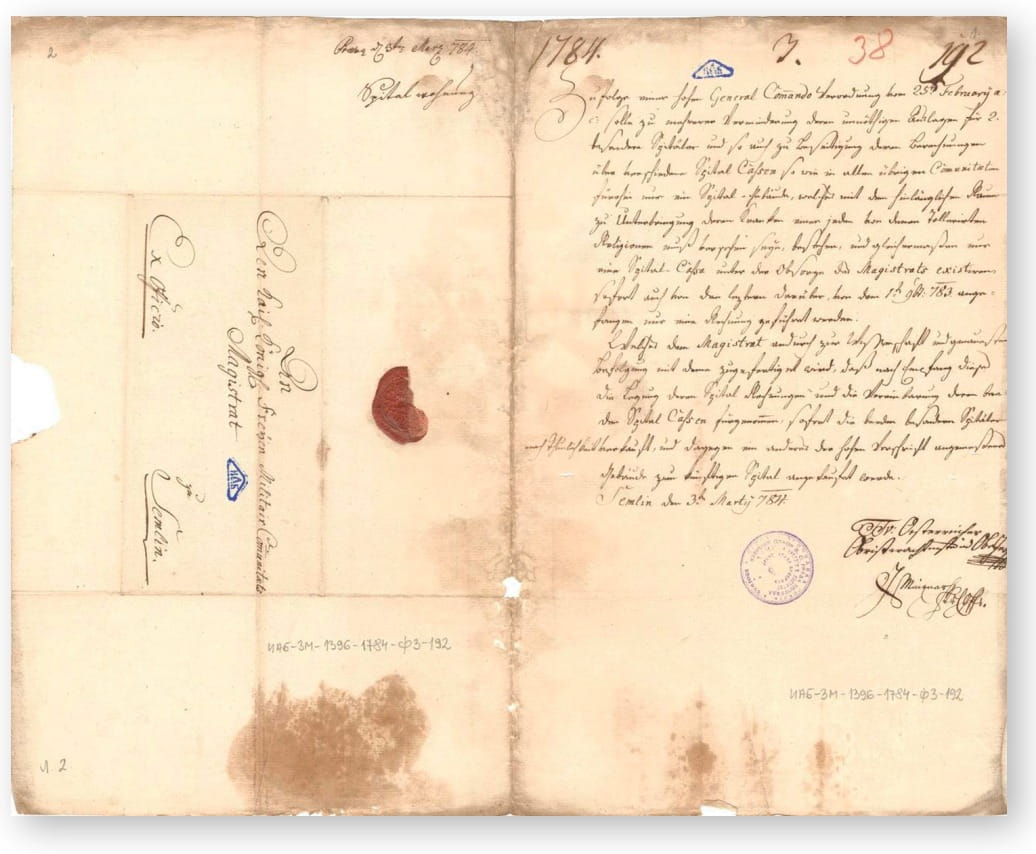
The Magistracy of Zemun provided financial aid to both the Serbian Hospital and the German Hospital. On February 25, 1784, the General Command issued an order on the merging of these two hospitals into one. This document signified the beginning of the founding of the new Town Hospital (Bürgerliches Spital) in Zemun [8]. The content of the order is as follows:
To the Imperial-Royal Free Military Community of Zemun
Official
Received: March 3, 1784
Hospital apartment
In keeping with the order issued by the General Military Command on February 25 of this year it is necessary to significantly decrease needless costs of separate hospitals, and cease keeping accounts through separate hospital treasuries. Also, in all other communities, there should be a hospital building which needs to have enough room for the hospitalization of patients of all allowed religions. There should also be only one hospital treasury supervised by the Magistracy. As to the latter, as of November 1, 1783, only one account shall be kept.
This is sent to the Magistracy for the purpose of delivering information and instruction, and upon reception it is necessary that hospital financial records be submitted, and the treasuries of both hospitals merged. Both hospital buildings need to be sold without delay and, consequently, a different building should be bought for the future hospital, which will conform to the state regulation. Zemun, March 3, 1784 Austrian major J. Maisner
(translated into Serbian by Zoran Stevanović, Archives of Vojvodina)
THE ZEMUN HOSPITAL IN THE 19TH CENTURY AND THE FIRST HALF OF THE 20TH CENTURY
When the new Town Hospital (Bürgerliches Spital) was founded in Zemun, the hospitals were not physically merged, but their finances were united. The name Bürgerliches Spital was used in the reports submitted to the Magistracy by the district appointed physicians for both hospitals, with a separate note stating that the report related to the Catholic or the Orthodox Christian Hospital [9]. It was not before 1795 that patients started being admitted only to the building of the German Hospital in Bežanijska Street. This is the year when the physical merging of the hospitals was finished, while in 1799 the final decision on closing down the Serbian Hospital was made. As neither of the buildings of the existing hospitals was adequate, plans for a new hospital building were made. As of 1802, the Magistracy considered building a new hospital, but, due to a lack of funds, finally, in 1805/6 only the adaptation of the existing building was carried out.
It was not just financial reasons that led to the establishing of a single Town Hospital in Zemun. The Sanitary Bill of 1770 was, as the fundamental health law for the entire country, applied in the territory of Zemun, as well. According to law, sanitation was divided into civil and military-border sanitation. The Sanitation Service in the Military Frontier was further divided into sanitation services for military units and military community district hospitals. The military community district hospitals were organized as prescribed by the Regulation for Military Communities of Zemun, Karlovci and Petrovaradin of 1787 [10]. The sanitation regulation stipulated that medical doctors, surgeons and apothecaries were obliged to prepare and pass exams at universities [9]. Hospital reports were submitted every month, diagnoses were written in German, mainly by symptoms, and the number of patients was up to 25. The diseases most commonly mentioned were malaria, typhoid fever, epidemic typhus, diphtheria, consumption, rheumatoid diseases, dysentery, St. Anthony’s fire, skin diseases ulcers, dropsy, sclerosis, pleurisy, edema, goiter, whooping cough, pneumonia, wounds, burns, mental illnesses. The venereal diseases mentioned were syphilis and gonorrhea. The commonly reported infectious diseases were scarlet fever, German measles and measles. Sometimes, cases of smallpox were also reported [10],[11].
In 1811, the General Command issued an Instruction on Hospital Management to the Magistracy according to which the hospital was organized. The Gynecological Department was formed the same year. Due to poor conditions in the hospital, the patients were still most commonly craftsmen, servants, and beggars, while the wealthier citizens were still treated by private physicians and remained at home. The hospital was expanded in 1821 when a neighboring house was bought, and by 1830 it had three rooms for male patients, one for female patients, and one room prisoners, with a total of 23 beds. The hospital fund was financed from regular income (fines for misdemeanors) and extraordinary gains, primarily legacies and donations. The number of patients increased over time. Thus, in 1829, a total of 195 patients were treated, whereas in 1886, there was a total of 458 hospitalized patients. As of 1887, outpatient treatment was introduced [12],[13].
The second half of the 19th century brought many changes to the functioning of the Zemun Hospital. The Town Council passed several decisions on the future running of the hospital, amongst them the new Hospital Code of Conduct. The old building could no longer meet the needs of an increasing number of patients. The appointment of Dr. Vojislav J. Subbotić to the position of district physician brought about improvements in the running of the hospital. Very soon, the “primary physician” of the Town Hospital, Dr. Subbotić transformed the hospital kitchen into an operating room where the first surgical procedures started to be performed. After negotiations, the Magistracy signed an agreement with the Order of the Sisters of Mercy of St Vincent Paulski, which took over management of the hospital on November 1, 1887. The Order took upon itself to build a General Public Hospital of the Sisters of Mercy with at least a hundred beds. The plans for the development of the new hospital were designed by Johan Nepomuk Holc from Slavonska Požega. By the fall of 1891 construction of the new hospital was completed, and on October 4, of the same year, the building was consecrated [11],[14].
The General Public Hospital was successfully managed by the sisters of mercy from 1891 to 1945. The Magistracy Health Board, chaired by the Town Mayor, supervised their work. In 1899 a nice single-storey building was erected on the hospital grounds which was intended for infectious patients. The hospital equipment was also modernized, and in 1901 a new X-ray machine was purchased; the hospital also had a sterilization machine. After the hospital building received an annex in 1905, the existing organization of the hospital was changed, which, up to that point had only one ward – the General Ward. The new organization created new wards - the Surgical Ward, the Internal Medicine Ward and the Venereal Diseases Ward. A new operating theatre was also constructed in that period. After 1905, the last major enlargement of the premises occurred in 1913, when a house was purchased from Dr. Taler’s widow, which was allocated for the housing of the hospital doctors and clergymen. During World War I, due to the increase in the number of patients, a temporary Hospital of the Red Cross Local Branch was opened in the building of the Town School for Boys. After the liberation of Zemun, on November 5, 1918, the hospital continued to work under the same name and under the same management [15],[16].
The hospital continued to work under the management of the sisters of mercy during the Kingdom of Serbs, Croats and Slovenes. In the 1920s the hospital had four wards - the Internal Medicine Ward, the Surgical and Maternity Ward, the Venereal Diseases Ward and the Ward for Infectious Diseases. The hospital employed 6 doctors, 40 sisters of mercy and support staff [17]. There were 268 beds, and, during the year 1928, more than three thousand patients were treated. In 1931 a second floor was added, as were new hospital wings, i.e. annexes to the sides of the ground floor. This significantly increased the capacity of the hospital. During World War II, Zemun was within the territory of the Independent State of Croatia, and the hospital remained under the management of the sisters of mercy. After the liberation of Zemun, on October 22, 1944, the hospital was transformed into a military facility for housing and treating wounded soldiers.
In the first days after the war, this health care facility was turned into the Military Hospital where doctors from Belgrade and Zemun worked together. The hospital carried out important work at the time of the breakthrough of the Srem front and in its aftermath, as a majority of the wounded soldiers were sent to this health facility. In addition to the existing building, other buildings were used as well - the building of today’s Svetozar Miletić Elementary School, the building of the Agriculture and Forestry Faculty, and, partially, the building of the Aviation Command. The most complicated surgical procedures were carried out in the building that is today the Faculty of Agriculture. On October 1, 1945, the Military Hospital was again transformed back into a civilian health care facility. It was housed in the old hospital building and it also used the building which was then the Infectious Diseases Ward (until 1946) and is now the Neurology Department. The Public General Hospital, as was its name at the time, had 432 hospital beds and 194 employees, of which 29 doctors and pharmacologists, 30 medical nursing staff, 43 orderlies and 92 non-medical staff. Within the organizational structure of that time the following existed: the Internal Medicine Ward, the Pediatrics Ward, the Surgical Ward, the Gynecology and Obstetrics Ward, the Dermato-venerology Ward, the X-ray Unit, the Laboratory and the Pharmacy.
Nine years later, in 1954, this hospital was registered as the Town Hospital, in 1965 it was renamed to the General Hospital in Zemun, and in 1973 it was registered as the Zemun Clinical Hospital. In the same year it was established as a legal entity with 12 organizational departments and one operational entity. After a referendum was carried out in 1978, it was reorganized into three organizational departments and one operational entity. The organizational departments comprised working units. There were organizational departments of Internal Medicine Branches, Surgery Branches, United Medical Diagnostic Services, and the Operational Entity for General Administration Services. On December 31, 1983 the hospital was given a new name, Zemun - Belgrade Medical Center, and was restructured. It consisted of the following: the Department of Internal Medicine, the Pediatric Department, the Dermato-venerology Department, the Department of Pneumophysiology, the Department of Physical Medicine, Rheumatology and Rehabilitation, the Department for Anesthesia and Reanimation, the Surgery Department, the Neurosurgery Department, the Department of Gynecology and Obstetrics, the ENT Department, and the Department of Urology [15].
The old building underwent major reconstruction in 1974, which was when a space for the Coronary Unit was adapted on the second floor. The surgical suite on the first floor was added in 1964, and in 1976 another one was constructed on the second floor. The new part of the building, which was used for outpatient clinical work, the pharmacy and the administration, was finished in 1965/1966 and it had four floors connected to the old building. The fifth floor was added to meet the needs of the Neurosurgery Department in 1976. In addition to the building in Vukova Street, the Medical Center also used the building at 57 Vrtlarska Street, where the Dermato-venerology Department operated at the time (this is now the location of the Neurology Department); the building at 32 Gundulićeva Street, where the Pediatric Department was housed; the building at 34 Gundulićeva Street, where the Department of Physical Medicine, Rheumatology and Rehabilitation was situated (this is now where the Department of Clinical Oncology is located); a separate building on the hospital grounds, used for the Financial Services; the building at No. 6 Izletnički put, where the Department of Pneumophysiology was situated; and finally, the vertical section of the Antituberculosis Dispensary in 22. oktobra Street, in Zemun, where the outpatient clinics for Diabetes, Ophthalmology and Neuropsychiatry were located (today this is the Department for Consultative and Specialist Examinations). In 1985, the Zemun - Belgrade Medical Center had more than 10,000 square meters at its disposal. The number of hospital beds increased every year, in keeping with the growth of the overall operation of this center and in line with the rationalization of its organizational structure. Thus, in 1954 the hospital had 546 beds, and in 1961 that number increased to 701. This number continued to rise in the following period, which, in 1984, amounted to 853 in all the buildings of the Zemun - Belgrade Medical Center.
In 1984, the Zemun - Belgrade Medical Center had state-of-the-art diagnostic equipment and implemented the most advanced diagnostic and therapeutic protocols and procedures of examining, testing and treating patients, of that time. The modern set of diagnostic equipment and methods for detecting different types of diseases comprised traditional, ultrasound and computerized diagnostic equipment and methods. The state-ofthe-art surgical suite comprising 10 operating theatres allowed the most complicated surgical procedures in the domains of general surgery, gynecology and obstetrics, urology, neurosurgery, and otorhinolaryngology with maxillofacial surgery, whose number surpassed 10,000 a year. Treatment of anaerobic infections, especially gas gangrene, was possible thanks to the hyperbaric chamber, which was in the Traumatology Division of the Surgery Department. This chamber was, as needed, used by all the different health care facilities from the SFRY, as it was unique and had demonstrated exceptional, until then, unattainable results. In 1984, the Zemun - Belgrade Medical Center had within its organizational structure the following intensive care units: the Coronary Unit, the Gastroenterology Intensive Care Unit, the Neurosurgery Intensive Care Unit, and the General Surgery Reanimation and Intensive Care Unit, with a total of 27 beds.
In 1972, the Zemun - Belgrade Medical Center became a teaching hospital of the Medical Faculty of the Belgrade University. One of the most important agreements was concluded with the Medical Faculty and thus, the Zemun – Belgrade Medical Center became one of the units of the Faculty. Teaching activities began with the students of the Faculties of Medicine and Stomatology and other faculties and colleges. The Zemun – Belgrade Medical Center was also among the first to establish cooperation with republic and federal institutions in outsourcing its professional staff to work abroad, especially in non-aligned and developing countries [12, 15].
Until 2009, some of the departments operated in close quarters with insufficient equipment and decreased hospital bed capacity, whose number was 688 at the turn of the 21st century, and after 2007 it was 620. Although the working conditions were difficult, the Department of Neurology was opened and the Division for Interventional Cardiology was formed; also, the Day Care Center was developed as well as the program of Clinical Oncology. At the end of 2010, the reconstruction and refurbishing of three floors of the central building with patient rooms was finished. At the beginning of 2012, the reconstruction was completed and five new operating theatres with full state-of-the-art equipment were introduced. At the beginning of 2015, a surgical suite with two new operating theatres, also equipped with stateof-the-art equipment, was put into operation. The Department of Hemodialysis, the Orthopedics Department and the Department of Laboratory Diagnostics were also renovated. The Zemun - Belgrade Medical Center, as a tertiary referral center, has introduced the implementation of the Eurotransplant concept, and has formed a team for organ explantation which has performed a number explantation procedures. Interventional neuroradiological procedures have been introduced and integrated into everyday procedure in cases of brain aneurisms. After necessary staff training abroad, endoscopic surgical procedures of the spine have been introduced as a part of standard procedure, with the Zemun - Belgrade Medical Center being the only place in Serbia where these procedures are carried out. Thus far, more than 1,000 of these operations have been performed. Today, the Zemun - Belgrade Medical Center provides, on a daily basis, timely, multidisciplinary and contemporary quality service, respecting ethical standards and good practice guidelines.
CONCLUSION
It was not easy to determine the exact time when organized health care began for the citizens of Zemun, and it was even more difficult to pinpoint the time when hospital treatment started. The beginning of hospital treatment was related to organized forms of health care in the Habsburg Monarchy and the position of Zemun within the empire. From the moment it obtained the status of free imperial town, in 1749, i.e. the status of a free military community with organized administration – the Magistracy, Zemun obtained certain rights to regulate and organize some aspects of health care independently. When a special bill was passed related to this issue, in 1770 (Generale normativum in re sanitates), which wasin force in all the territories of the monarchy, the care for the health of the citizens became the duty of the state. Since its founding, on February 25, 1784, until now, the Zemun Hospital has gone through different phases. It has been transformed from a shelter and refuge for the poor to a modern medical center. Both the old and the new are reflected in the very buildings that are a part of the hospital; there are buildings which are under the protection of the state as historical sites, but also modern hospital wings built to meet their specific purpose. However, what primarily shaped the hospital into what it is today are the people who worked in it and those who managed it. Each one of them has left their mark and built their enthusiasm into the hospital – from Dr. Vojislav J. Subbotić, who established the first operating room by transforming the hospital kitchen, to the people who work today in state-of-the-art operating theatres. The Order of the Sisters of Mercy of St Vincent, who took over running the hospital on November 1, 1887, left a special mark on the development of the hospital. The order took upon itself to build the General Public Hospital in Zemun, which was indeed done by the fall of 1891. During the 20th century the hospital shared the fate of the community, working without interruption throughout both world wars. In that period, it operated within several different countries, only to become one of the leading medical institutions of the Republic of Serbia today.
Informations

-
Keywords:
-
Received:
-
Revised:
-
Accepted:
-
Online first:
-
DOI:
-
Cite this article:

Sanja Milenković
“Zemun“ Medical Center
9 Vukova Street, 11000 Belgrade, Serbia
E-mail:
1. Bazala V. Dokumenti o zdravstvu u Vojnoj krajini, naročito o takozvanom kužnom kordonu. Acta Historica medicinae pharmaciae, veterinae. 1961;2: 64-82.
2. Jeremić R. Medicinske prilike u Zemunu 1750-1900. Beograd; 1937.
3. Jeremić R. Zdravstvene prilike u Jugoslovenskim zemljama do kraja devetnaestog veka. Zagreb; 1935.
4. Katić R. Srpska medicina od IX do XIX veka. Beograd; 1967.
5. Katić R. O prošlosti Srpske bolnice u Zemunu i razlozima austrijskih vlasti za njeno ukidanje. Acta Historica medicinae pharmaciae, veterinae. 1964; 1-2: 128-132.
6. Dabižić M. Zavičajni muzej - pregled prošlosti Zemuna. Beograd; 1973.
7. Zemun u doba Vojne granice kroz dokumenta (1749-1881). Beograd; 1956.
8. Milanović J, Milenković S, Pavlović M, Stojanović D. Osnivanje Zemunske bolnice, Srpski arhiv za celokupno lekarstvo. 2014; 142 (7/8): 505-10.
9. Istorijski arhiv Beograda, Zemunski magistrat, 1396-1784-F 3-192; 1438- 1789-F37-17; 1684-1800-F66-227.
10. Marković P. Zemun od najstariji vremena pa do danas. Zemun; 1896.
11. Milenković S, Milanović J. Kliničko bolnički centar Zemun kroz vekove – 18. vek, Materia Medica 2014; 30 (1): 979-88.
12. Dabižić M, Ostojić D, Hadžagić U, Gril D, Janjatović T, Ninković R, i sar. Dvesta godina Zemunske bolnice 1748-1984. Beograd; 1985.
13. Živković J, Milanković P, Prica R. Zdravstvene prilike u području Petrovaradina početkom 19. veka i osnivanje bolnice u Sremskoj Mitrovici. Acta Historica medicinae pharmaciae, veterinae. 1969; 1-2: 175-80.
14. Milanović J, Milenković S. Kliničko bolnički centar Zemun kroz vekove – 19. vek, Materia medice. 2014, 30 (1): 989-1003.
15. Milenković S, Milanović J. Kliničko bolnički centar Zemun kroz vekove – 20. vek, Materia medice. 2014, 30 (1): 1004-17.
16. Milanović J, Milenković S, Kos M. Rad milosrdnih sestara Sv. Vinka Paulskog u bolnicama u Zemunu i Zagrebu, Istorija 20. veka. 2020, XXXVIII (1): 51-64.
17. Sremski glasnik, 1929, VI (12): 2; 1929, VI (20): 2-9.