


Possibilities of using inertial measurement unit sensor for assessing balance abilities in the elderly
- Academy of Applied Studies Belgrade, College of Health Sciences, Belgrade, Serbia
- University of Belgrade, Institute for Medical Research, Belgrade, Serbia
- University of Belgrade, Faculty of Medicine, Institute of Medical Physiology “Richard Burian”, Belgrade, Serbia
- University of Kragujevac, Faculty of Medical Sciences, Kragujevac, Serbia
- Center for Brain and Neurotechnology, Moscow 117513, Russia
- Research and Clinical Centre, Moscow 107031, Russia
ABSTRACT
Aim: This study aimed to evaluate age-related changes in postural stability among healthy older adults using inertial measurement unit (IMU) sensors and assess the clinical potential of wearable technology for balance assessment in geriatric populations.
Methods: Thirty-four healthy participants aged > 65 years were divided into two age groups (65–75 and > 75 years). Balance was assessed using a sacrum-mounted IMU sensor during a 30-second semi-tandem stance in three trials.
Results: Participants > 75 years showed increased postural sway compared to younger counterparts. Gender differences revealed greater medio-lateral sway in males (p = 0.038). No significant differences were observed in sway velocity or ellipse area, suggesting effective compensatory mechanisms in static conditions.
Conclusion: IMU-based balance assessment demonstrates sensitivity in detecting subtle age-related postural changes, with practical advantages for both clinical and community settings.
INTRODUCTION
Balance is a fundamental component of human movement. The function of balance is maintained by specific physiological mechanisms that regulate postural stability through precise spatiotemporal regulation of the center of mass (COM) relative to the base of support [1]. This requires the continuous integration of multiple sensory inputs, including gravitational cues, support surface characteristics, visual information, and proprioceptive feedback, to achieve optimal body orientation [2].
Maintaining balance during anti-gravitational activities and sustaining proper posture form the foundation for executing more complex movements. These secondary movements enable us to propel ourselves through space or interact with our surrounding environment [3]. Balance and gait play a vital role in maintaining the overall well-being and independence of elderly individuals.
Unfortunately, older adults face an increased risk of falls due to age-related physiological changes - spanning slowed balance reactions, sensory deficits, medication effects, and neuromuscular deterioration, which disrupt the complex sensorimotor coordination underlying postural control [4].
Difficulties in these areas not only increase the risk of falls and injuries but also contribute to reduced mobility and social isolation. Studies show that approximately 13% of adults aged 65 to 69 report balance-related issues-a figure that rises sharply to 46% among those aged 85 and older. Similarly, gait disorders are a prevalent concern, affecting approximately 35% of non-institutionalized adults aged 70 and older. These disorders are not only linked to reduced mobility but also correlate with a 2.2-fold increase in the risk of institutionalization and mortality compared to those without gait issues [5]. These statistics underscore the urgent need for early identification, prevention strategies, and tailored interventions to maintain mobility and reduce health risks in aging populations. Given the serious consequences of falls among older adults, assessing balance disorders is a standard and essential practice in geriatric care and rehabilitation. Early identification and intervention can significantly reduce the risk of falls, preserve independence, and improve overall quality of life.
Clinical tools such as the Berg Balance Scale, Timed Up and Go (TUG) test, Functional Reach Test, and Tinetti Test are widely used due to their efficiency, reliability, and ability to provide valuable insights into fall risk. However, these assessments rely heavily on subjective interpretation by evaluators, which can compromise their accuracy and consistency. Furthermore, they may lack the sensitivity required to distinguish between individuals in relatively healthy populations, limiting their utility in early or subtle balance impairments [6].
These clinical needs drove the development of instrumental balance assessment during quiet stance, which became standardized in clinical practice during the mid20th century. Among the various technological approaches developed, force platform posturography emerged as the gold-standard methodology, utilizing embedded force sensors to quantify center-of-pressure dynamics. This technique is also known by several names, including stabilometry or stabilography, among others [7].
The fact is that traditional stabilometry, as it is, has certain limitations. Stabilometric platforms very often have relatively large dimensions and weight due to technical requirements. Therefore, in a clinical context, their use is hampered by a lack of portability. Apart from the mentioned, to obtain data in the patient’s coordinate system—specifically, one that considers the orientation and position of the patient’s feet—it is necessary to position the feet on the measurement platform in a predefined manner. Established standards for foot placement exist to guide this process. In some instances, the dimensions of the patient’s feet are also used to define the coordinate system in which examination results are presented [7]. However, this practice can introduce variability and lead to a relativization of the measurement outcomes, potentially affecting their consistency and comparability.
A suitable alternative to traditional stabilometry is the measurement of balance parameters using inertial sensors, such as inertial measurement units (IMUs), which typically contain three-component accelerometers. Essentially, IMU systems are based on a specialized chip that contains sensors located in three mutually perpendicular planes. Optimal sensor positioning is task-dependent, with anatomical placement strategically selected to capture relevant kinematic parameters for the targeted postural assessment [8]. Wearable inertial sensors are typically positioned at the waist or trunk to quantify postural sway and trunk acceleration kinematics. Alternative mounting locations (lower limbs, sternum, upper extremities, or forehead) provide segment-specific movement data, with triaxial configurations enabling comprehensive 3D spatiotemporal analysis of joint and body segment dynamics [9].
After all, it is worth noting that IMU systems, being cost-effective, lightweight, and capable of administering postural assessments in diverse environments without spatial constraints, are particularly suitable for testing the elderly population. The most important aspect is that they provide detailed information on subtle changes in postural sway for both static and dynamic conditions.
In our study, we aim to use an IMU sensor to assess individuals over 65 years of age and evaluate their ability to maintain balance.
METHODS
Participants
The study included 34 healthy adults (male, 5; female, 29) aged 65 years or older, divided into two groups (65- 75 years and >75 years). We excluded participants with neurological, orthopedic, or cardiovascular conditions that affected balance, those using mobility aids, and individuals taking relevant medications. Participants provided written informed consent, and the study was approved by the Ethical Committee of FSBI at the Center for Brain and Neurotechnology (No. 7, July 19, 2021), in accordance with the Declaration of Helsinki.
Study design and measurement procedures
Balance assessments were performed using the Neurosoft IMU sensor (Neurosoft, Ivanovo, Russia), positioned near the sacrum level (L2-S2) via an elastic band holder, in accordance with established methodology [8] (Figure 1). This placement captures body oscillations near the center of mass while monitoring pelvic movements. Participants maintained a semi-tandem stance (dominant leg forward, hands on hips) with eyes open for 30 seconds, remaining motionless. Following an initial familiarization trial, three test repetitions were conducted, with 10-second rests between each trial. The integrated triaxial accelerometer recorded data at 200 Hz, with wireless transmission to dedicated PC software for analysis.
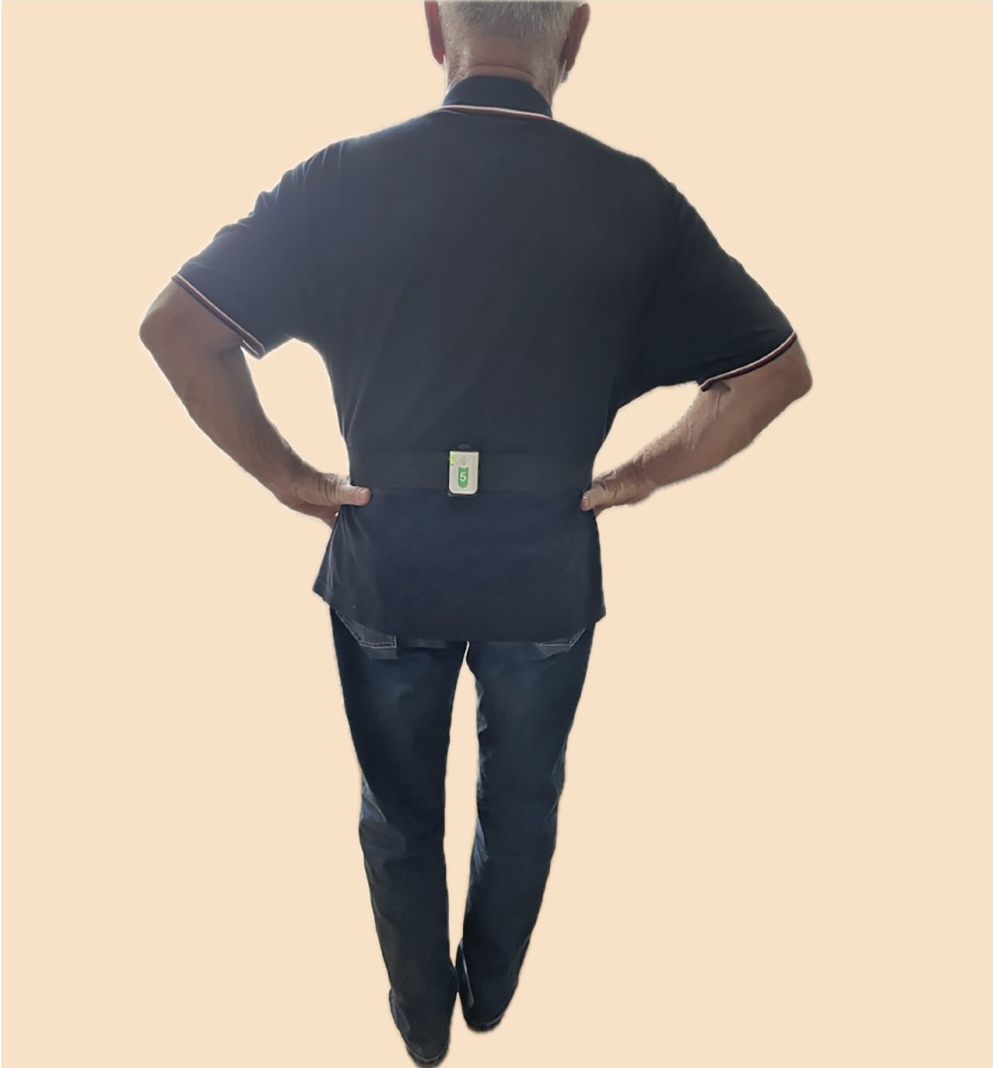
In the study, we analyzed parameters of postural stability measured using IMU sensors. For each participant, average values were calculated from three measurements for the following indicators:
- sway mean X – mean center of pressure (COP) displacement in the left-right (X) direction,
- sway mean Y – mean COP displacement in the anterior-posterior (Y) direction,
- mean sway velocity,
- ellipse area encompassing 95% of oscillations.
Statistical analysis
The Kolmogorov–Smirnov and Shapiro–Wilk tests were used to assess the normality of data distribution. Since the data did not follow a normal distribution, the Mann–Whitney U test was used to compare differences between the two groups, and the data were presented as medians (with minimum and maximum values).
RESULTS
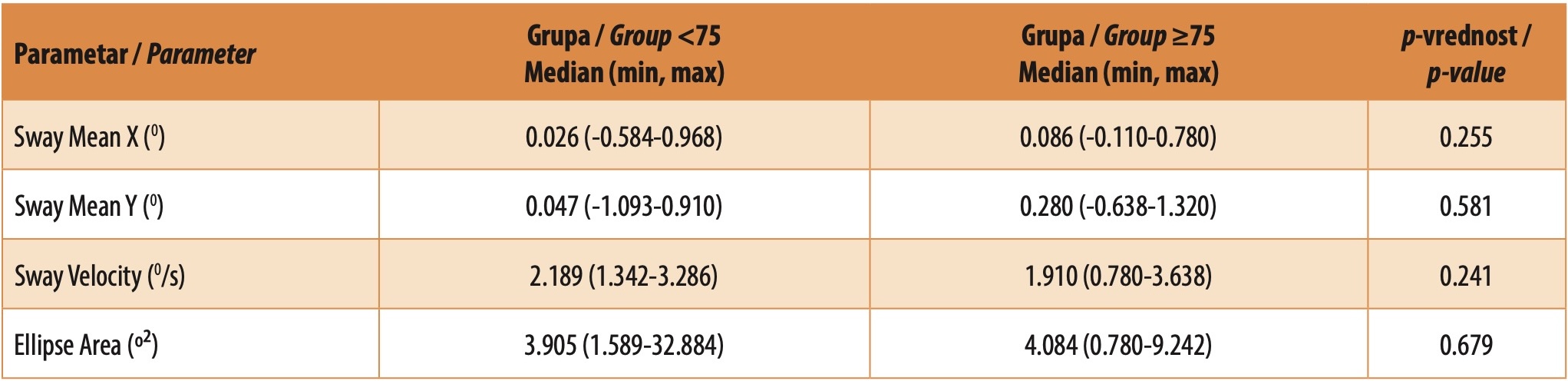
The group ≥ 75 showed greater mean oscillations in both the X and Y directions, which may indicate higher instability (Table 1). However, these differences were not statistically significant (p > 0.05). Similarly, there were no significant differences in sway velocity or ellipse area, suggesting that the groups did not differ in overall postural control.
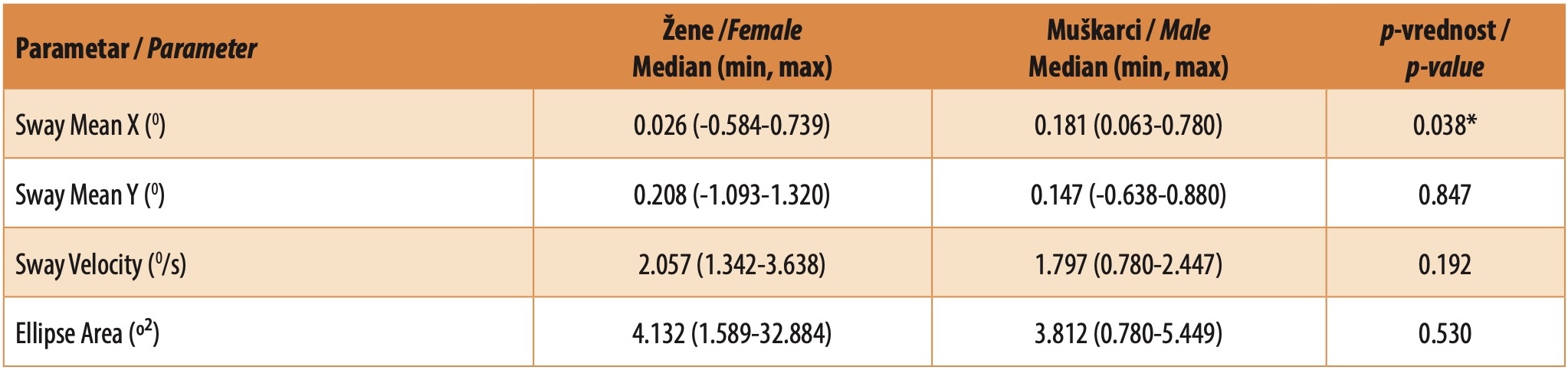
Males exhibited statistically significantly greater oscillations in the X direction (p = 0.038), while females showed higher sway velocity and ellipse area, although these differences were not statistically significant (Table 2).
DISCUSSION
The investigation of postural stability in healthy older adults using IMU sensors revealed specific trends, although most results did not reach statistical significance. These findings may provide insights into the aging process and its impact on balance, while simultaneously raising questions for further research.
Increased oscillations in the X and Y directions in participants older than 75 years (Table 1) are consistent with existing studies, which indicate a progressive deterioration of balance with age [10],[11]. This can be attributed to the decline in sensory and motor functions, including loss of muscle mass and impairment of the vestibular system [11],[12]. However, the absence of statistically significant differences in sway velocity and ellipse area may suggest that healthy older adults maintain stability in static conditions through compensatory mechanisms [13]. The slight increase in oscillations among older participants may have clinical significance, as previous research shows that even minor changes can increase fall risk [14],[15].
Gender differences in postural control manifest primarily in mediolateral sway during static standing [16],[17]. Notably, stance stabilization (wider foot placement) produces greater sway reduction in older males compared to females, suggesting males exhibit poorer stability in narrow stance configurations [18]. These differences, though subtle, indicate the need for gender-specific approaches in balance disorder assessment and treatment.
The use of IMU sensors enabled a simple and objective assessment of balance in natural conditions. Those are reliable tools for measuring postural stability, particularly excelling in the mediolateral direction for low-difficulty tasks [19]. In the context of fall prediction, inertial measurement units (IMUs), typically represented by accelerometers, have been used to distinguish between fallers and non-fallers, as well as to assess the risk of falling [20].
However, the small sample size and homogeneous population may have contributed to the lack of significant differences. Future studies should include larger participant numbers and individuals with mild balance disorders to understand the early signs of fall risk better. Additionally, evaluating further parameters (e.g., the frequency spectrum of oscillations) could yield more precise conclusions.
Although the differences were slight, continuous monitoring of postural stability using IMU sensors could be beneficial for early detection of changes that precede falls [20]. This technology offers advantages over clinical tests by enabling quantitative and repetitive assessment with minimal equipment. Prospectively, combining IMU sensors with other modalities, such as EEG or electromyography, could provide deeper insight into the mechanisms of balance maintenance [21].
CONCLUSION
This study may contribute to the understanding of age-related changes in balance control and demonstrates the potential clinical utility of IMU sensors for postural assessment. The practical advantages of our sacral-mounted IMU protocol – including portability, real-world applicability, and biomechanical relevance to COM movements – position this approach as a valuable tool for community-based geriatric assessments.
Future research should focus on expanding the sample size and integrating sensor-derived data with clinical balance measures to enable more precise risk stratification.
Informations

-
Keywords:
-
Received:
-
Revised:
-
Accepted:
-
Online first:
-
DOI:
-
Cite this article:

Nenad Nedović
College of Health Sciences, Academy of Applied Studies Belgrade
254 Cara Dušana Street, 11080 Belgrade, Serbia
E-mail:
1. Rogers MW, Mille M-L. Balance perturbations. Handb Clin Neurol. 2018;159:85-105.
2. Kongsawasdi S, Wiboonsuntharangkoon C, Tajarernmuang P, Wantanajittikul K. Feasibility study of a prototype wearable inertial measurement unit for elderly postural sway assessment. J Clin Med Res. 2024 Apr;16(4):174-81. doi:10.14740/jocmr5125. [CROSSREF]
3. Panjan A, Sarabon N. Review of methods for the evaluation of human body balance. Sport Sci Rev. 2010 Dec;19(5-6):131-63.
4. Horak FB. Postural orientation and equilibrium: what do we need to know about neural control of balance to prevent falls? Age Ageing. 2006 Sep;35 Suppl 2:ii7-ii11. doi: 10.1093/ageing/afl077. [CROSSREF]
5. Rodríguez-Almagro D, Achalandabaso-Ochoa A, Ibáñez-Vera AJ, Góngora-Rodríguez J, Rodríguez-Huguet M. Effectiveness of virtual reality therapy on balance and gait in the elderly: a systematic review. Healthcare (Basel). 2024 Jan;12(2):158. doi:10.3390/healthcare12020158. [CROSSREF]
6. Kongsawasdi S, Bunjan P, Wongjak M, Saenmueng W, Wantanajittikul K. Evaluating postural sway in the elderly using inertial measurement units: a study on center of mass measurements via accelerometers and gyroscopes. J Clin Med Res. 2025 Apr;17(4):200-7. doi:10.14740/jocmr6184. [CROSSREF]
7. Skvortsov D, Painev N. Postural stability Romberg’s test in 3D using an inertial sensor in healthy adults. Symmetry (Basel). 2023 May;15(5):1125. doi:10.3390/sym15051125. [CROSSREF]
8. Ghislieri M, Gastaldi L, Pastorelli S, Tadano S, Agostini V. Wearable inertial sensors to assess standing balance: a systematic review. Sensors (Basel). 2019 Sep;19(19):4075. doi:10.3390/s19194075. [CROSSREF]
9. Zampogna A, Mileti I, Palermo E, Celletti C, Paoloni M, Manoni A, et al. Fifteen years of wireless sensors for balance assessment in neurological disorders. Sensors (Basel). 2020 Jun;20(11):3247. doi:10.3390/s20113247. [CROSSREF]
10. Lockhart TE, Frames CW, Soangra R, Lieberman A. Effects of Obesity and Fall Risk on Gait and Posture of Community-Dwelling Older Adults. Int J Progn Health Manag. 2019;10(1):019.
11. Wang J, Li Y, Yang GY, Jin K. Age-related dysfunction in balance: a comprehensive review of causes, consequences, and interventions. Aging Dis. 2024;16(2):714-37. doi:10.14336/AD.2024.0124-1. [CROSSREF]
12. Iwasaki S, Yamasoba T. Dizziness and imbalance in the elderly: age-related decline in the vestibular system. Aging Dis. 2015;6(1):38-47. doi:10.14336/ AD.2014.0128. [CROSSREF]
13. Virk S, McConville KM. Virtual reality applications in improving postural control and minimizing falls. Conf Proc IEEE Eng Med Biol Soc. 2006;2006:2694- 7. doi:10.1109/IEMBS.2006.260751. [CROSSREF]
14. Hodgson G, Pace A, Carfagnini Q, Ayanso A, Gardner P, Narushima M, et al. Risky business: factors that increase risk of falls among older adult in-patients. Gerontol Geriatr Med. 2023;9:23337214231189930. doi:10.1177/23337214231189930. [CROSSREF]
15. Hsieh KL, Speiser JL, Neiberg RH, Marsh AP, Tooze JA, Houston DK. Factors associated with falls in older adults: a secondary analysis of a 12-month randomized controlled trial. Arch Gerontol Geriatr. 2023;108:104940. doi- :10.1016/j.archger.2023.104940. [CROSSREF]
16. Kim JW, Eom GM, Kim CS, Kim DH, Lee JH, Park BK, et al. Sex differences in the postural sway characteristics of young and elderly subjects during quiet natural standing. Geriatr Gerontol Int. 2010;10(2):191-8. doi:10.1111/j.1447-0 594.2009.00576.x. [CROSSREF]
17. Kim JW, Kwon Y, Ho Y, Jeon HM, Bang MJ, Jun JH, et al. Age-gender differences in the postural sway during squat and stand-up movement. Biomed Mater Eng. 2014;24(6):2707-13. doi:10.3233/BME-141088. [CROSSREF]
18. Sullivan EV, Rose J, Rohlfing T, Pfefferbaum A. Postural sway reduction in aging men and women: relation to brain structure, cognitive status, and stabilizing factors. Neurobiol Aging. 2009;30(5):793-807. doi:10.1016/j.neurobiolaging.2007.08.021. [CROSSREF]
19. Liu Y, Liu X, Wang Z, Wang J, Zhang H, Guo L. Improving performance of human action intent recognition: analysis of gait recognition machine learning algorithms and optimal combination with inertial measurement units. Comput Biol Med. 2023;163:107192. doi:10.1016/j.compbiomed.2023.107192. [CROSSREF]
20. Wang T, Liu M, Bao B, Zhang Y, Wang J, Liu Y. Balance evaluation system using wearable IMU sensing. Meas Control. 2024;58(2):281-92. doi:10.1177/00202940241258828. [CROSSREF]
21. Germanotta M, Mileti I, Conforti I, Del Prete Z, Aprile I, Palermo E. Estimation of human center of mass position through the inertial sensors-based methods in postural tasks: an accuracy evaluation. Sensors (Basel). 2021;21(2):601. doi:10.3390/s21020601. [CROSSREF]