


Citing literature
- Institute of Preventive Medicine, Faculty of Medicine, University of Priština, Kosovska Mitrovica, Serbia
ABSTRACT
Publishing the results of research is the final outcome of a research paper – what has not been published is considered not to have existed. The aim of publishing research is to promote an original idea or to improve existing ideas, with the use of reliable sources. When writing different types of publications (research and professional papers, doctoral theses, books, etc.) it is necessary to state the sources that the ideas or text related to that publication were taken from. Science did not start with the authors of any individual research paper nor will it end with them – whatever the topic of the research is, there is a high probability that someone has already written something about it. If other authors’ ideas or text are used in one’s research, this must be stated in the text of that research. The standardized method of referring to sources is citing. Sources are cited in three ways: by quoting, paraphrasing, and summarizing. Citing sources may be direct and indirect. Sources may be referred to in the text (citing), at the end of the page (footnote), or at the end of the paper (endnote). Different sources may be cited: books, scientific journals, pictures, videos, audio sources, etc. The basic citation unit is a reference. Software for reference management enables the authors of publications to gather and organize references, insert quotes into the text, and create a bibliography. There are many such different programs. Some can be used free of charge (Mendeley, Zotero), while others must be purchased (EndNote). With the development of Internet technology, this type of software is also developing new functions in order to facilitate cooperation and networking amongst researchers, as well as to assist in the development of academic social networks. Accurate citing ensures the integrity of existing scientific knowledge that is being presented, it contributes to the reputation of a scientific journal, and strengthens the credibility of the author and the research itself.
CITING
Publishing is aimed at promoting an original idea or improving existing ideas, with the use of reliable sources. When writing different types of publications (research and professional papers, doctoral theses, books, etc.) it is necessary to state the sources that the ideas or text related to that publication were taken from. Research papers got their current form in the period 1780 – 1790, while citing references started in the middle of the 19th century. With the development of science and information and communication technologies, the body of published work has increased, while a number of electronic journals and databases have emerged. The estimation is that there are currently around 30,000 journals in the world and that, so far, around 50 million articles have been published [1].
When authors write their own work, a large number of publications is available to them, and the work of the authors whose ideas, theories or research have directly influenced this work needs to be cited [2]. The newly written work is a reflection of the knowledge of the author, which was built on the work of other authors [3].
Citing literature represents a standardized method of presenting the sources of information and the ideas used in writing a research paper, in a unique way that identifies these sources [4]. Information sources included in the text of a publication are cited in three ways: by quoting, paraphrasing or summarizing. Quoting is using original parts of other authors’ texts (more than six consecutive words, copied correctly, put in quotation marks, where each word and punctuation mark must be exactly the same as in the original work) [5]. Paraphrasing is conveying ideas or parts of another author’s text in the form of one’s own words. Summarizing is a short description of ideas, through relaying the main points, while giving a personal interpretation of these ideas. Sources can be referred to within the text (citing), at the bottom of the page (footnote), or at the end of the paper (endnote).
There are two interrelated parts of the procedure of referring to sources [6]: a citation is basically a label placed within the text in order to refer to a particular source, while a reference provides all the data on the source so that, based on this information, it is possible to find the original source. References are listed in an organized, structured and consistent manner at the end of the text. The list of references is a catalogue of the literature used and is organized either in alphabetical order of the authors’ names or by the order of citing in the text of the paper, which depends on the citation style being used. The bibliography is presented at the end of the paper, in the same way that the references are presented. The difference between the list of references and the bibliography is in the fact that the list of references lists only the publications cited in the text, whereas the bibliography lists all the sources used when writing the paper, those cited and those not cited.
THE IMPORTANCE OF CITING
For the author of the work being published, citing provides proof related to the presented research, proof as to the extent of the author’s in-depth reading in the particular scientific area, and proof of the extent of the author’s knowledge of the topic he/she is writing about. The author’s argumentation is more convincing when it is supported by ideas of acknowledged experts and by data from reliable sources. Citing directs readers towards information sources and enables them to differentiate the original ideas of the author from the ideas of other authors being cited, which gives the author of the work being published the deserved recognition for his/her unique contribution to the topic.
For the authors whose work is cited, citing is recognition of their work. In the academic world, ideas are currencies. Citing accumulates this currency and strengthens the credibility of the authors whose work is being cited.
Citing provides the academic community with a path which quickly and effortlessly leads the readers to the cited sources. It enables readers to observe the development of an idea, to easily check the precision and reliability of the content of the research, and to further research the topic. Proper citing is one of the strategies of preventing plagiarism.
CITATION SOURCES
Every piece of information documented in a text, an audio or visual recording can be used as a source and cited. The examples of sources that can be cited are: books, research and professional articles, journals (printed and electronic), doctoral theses, all other academic work, conference papers, web pages, pictures, photos, drawings and diagrams, E-mail communication, social media posts, video and audio recordings, radio and TV shows, newspapers and magazines, personal communication.
CITATION STYLES
The citation style is a standardized method for presenting sources in the text and at the end of a research paper or at the end of any other publication. There are several thousand citation style variants which contain the same metadata on the source being cited, but this data is organized and formatted in different ways within different citation styles. Regardless of the citation style being used in a scientific paper, sources are cited in the Introduction, Methods and Discussion sections of the paper. Citation styles can conceptually be divided into two major systems: author-number (Vancouver Style) and author-date (Harvard Style). These two citation styles and their modifications are the ones most commonly used in most journals and books in the field of medicine.
The Vancouver rules stipulate the numerical method of citing; references are marked in Arabic numerals, in brackets, in the order of their appearance in the text. In the list of references, the references are listed according to their order of appearance in the text. [7]. In various subvariants of this citation system, the identification numbers of the references may be: in round brackets (1), in square brackets [1], in superscript 1 or presented in a combined manner [1]. In the Vancouver Citation System, adding or removing references during the process of writing a paper is more difficult, once the list of references and their citations within the text have already been entered [8].

In the Harvard Citation Style, the references are marked by the last name of the author and the year of publication within the text itself, while in the list of references the references are listed in alphabetical order, according to the last name of the first author [9]. The Harvard System makes it easy to add or remove references from the text of the paper and from the references list at the end of the paper. However, this system has two flaws – it is more difficult to find the part of the text where a particular reference from the References section has been cited; also, the process of citing within the text of the paper is more difficult, especially when a larger number of references needs to be cited [5],[8].
REFERENCING ERRORS
Accuracy in citing is a fundamental aspect of scientific literature since new research develops in the context of the conclusions made in previous research [10]. More errors can be found in the References section of published research papers than in any other section of these papers [11]. Careful analysis shows that citation errors in published papers are quite frequent. In addition to incorrect spelling, mistakes in the titles of the cited publications, errors in the year of publishing or the number of pages, citations are often not relevant to the paper being written or do not support the ideas presented in that the paper [12]. Referencing mistakes can be related to - citing errors and errors in presentation. Citing errors include errors in the data elements of the reference being cited [13], while errors in presentation are considered more serious and are defined as citations where the cited reference is in direct opposition, does not substantiate or is not relevant to the paper that it is being cited in [14]. Referencing mistakes lead to the circulation of false “established facts” in scientific literature, which are difficult to rectify [5]. Using reference management software can facilitate a reduction in referencing errors while many systems for online editing and publishing of journals use reference checking software [15].
REFERENCE
A reference is the basic unit of citation. In bibliographic literature a reference is called a bibliographic unit. A bibliographic unit is a collection of bibliographic elements integrated into an independent and meaningful unit.
REFERENCE MANAGEMENT SOFTWARE
Reference management software enables the user to collect and organize references, insert quotes into the text, and compile a bibliography. It enables using different referencing styles and converting references from one style to another. With the development of social networks this software developed so as to enable networking and cooperation amongst users.
Reference management software should enable the user to: search for references in available academic databases, take over references from databases, catalogues and Internet sites, as well as to take over metadata on the reference from PDF files. It also enables the following: organization – saving, organizing and storing references, adding a complete text of a publication (e.g., in the PDF or DOCX format) or a picture to the reference, as well as adding comments to the reference or PDF file; citing – adding quotes into the text, creating a bibliography, support for different citation styles, communication in the form of exporting and importing references in different formats, compatibility and cooperation in activating the software on different platforms (Windows, Linux, iOS), group work, and reference exchange.

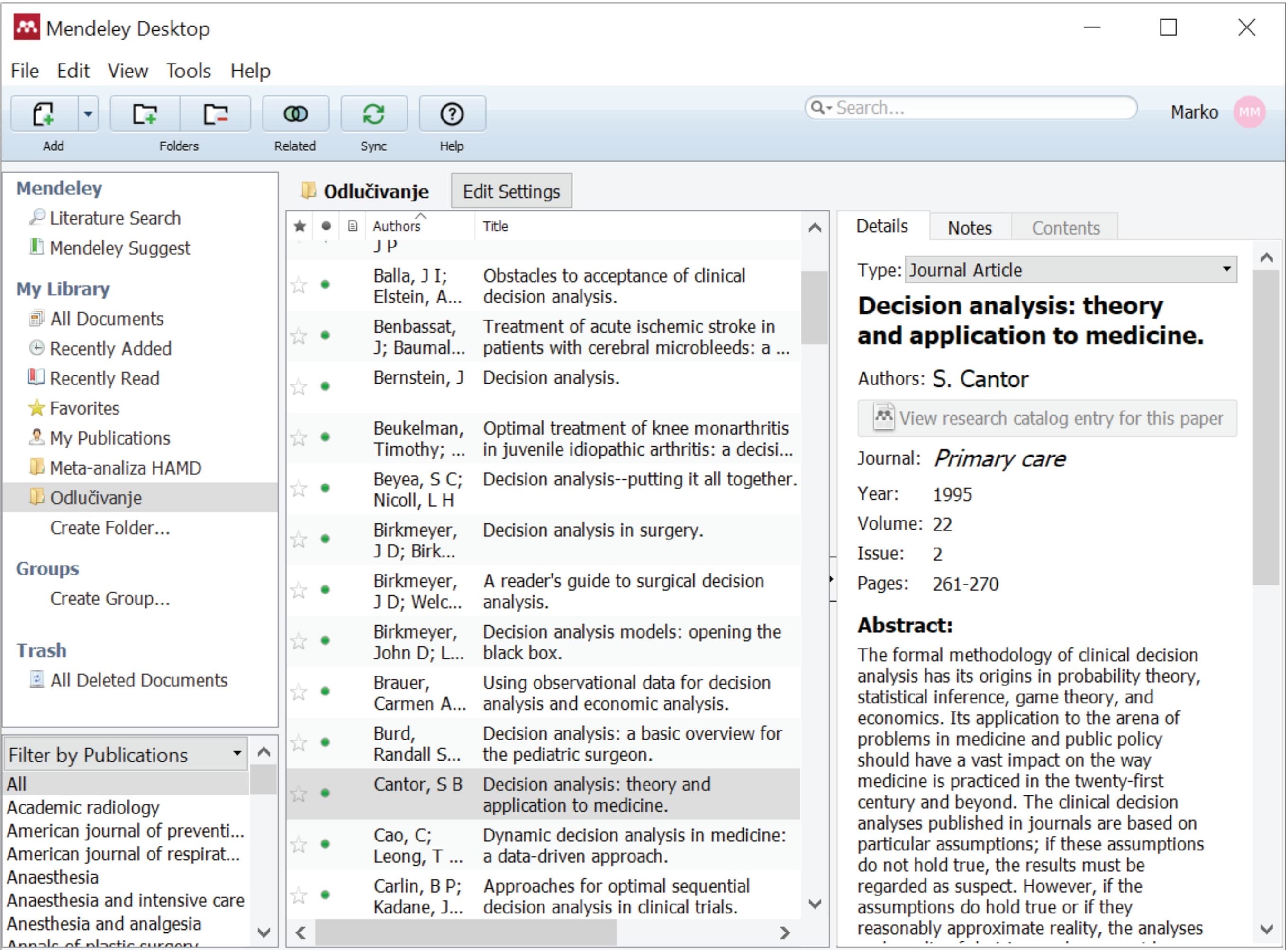
There are more than 30 different programs for reference management. Some are independent applications, some operate within an Internet interface, and there are also programs which combine the two modes of operation. The most frequently used programs are Mendeley (www.mendeley.com), EndNote (www.endnote.com) and Zotero (www.zotero.org).
Each one of the above-mentioned software programs for reference management has its strengths and weaknesses. None of them are ideal nor universally applicable. Lately, Mendeley is being used more and more, as it is free and its use is simpler than is the case with EndNote software, while, at the same time, it offers more options than the Zotero program. A detailed instruction on the use of the Mendeley software in the Serbian language is available on the webpage of this journal (https://casopis.rlkbg.org.rs/images/casopis/MENDELEY_-_uputstvo.pdf).
Accurate citing ensures the integrity of existing scientific knowledge, it contributes to the reputation of a scientific journal, and strengthens the credibility of the author and the research itself. Citing errors are still present in medical literature, which leads to the acceptance of false facts. However, the increasing availability of electronic sources and reliance on electronic literature makes it easier to apply reference management software. It is up to the authors, reviewers and editorial boards of journals to promote, through different activities, the application of reference management software in the compilation of bibliographies in research papers, which can significantly influence the reduction in citing errors.
Informations

-
Keywords:
-
Received:
-
Revised:
-
Accepted:
-
Online first:
-
DOI:
-
Cite this article:

Aleksandra Ilić
Institute of Preventive Medicine, Faculty of Medicine,
University of Priština, Kosovska Mitrovica, Serbia
Anri Dinana b.b, 38220 Kosovska Mitrovica, Serbia
E-mail:
1. Matutinović FS. Naučne informacije u Srbiji. Protok, dostupnost, vrednovanje. Drugo izdanje. Beograd; 2013.
2. American Psychological Association (APA). Publication manual of the American Psychological Association. 6th ed. Washington: DC: Author; 2010.
3. Hicks R. I write, therefore, I cite: why and how tools can help the author. J Am Assoc Nurse Pract. 2014; 26(4):177-8.[CROSSREF]
4. Milic N, Stanisavljevic D, Trajkovic G, Miličić B, Bukumirić Z, Gajić M i Mašić S: Biomedicinska informatika. Foča: Medicinski fakultet Foča; 2017.[GoogleScholar]
5. Bahadoran Z, Mirmiran P, Kashfi K, Ghasemi A.The Principles of Biomedical Scientific Writing: Citation. Int J Endocrinol Metab. 2020; 18(2):e102622.[CROSSREF]
6. Birmingham City University. How to write references. Harvard Referencing Guidelines; 2020. [citirano septembar 2020.]. Dostupno na: https://bcuassets.blob.core.windows.net/docs/bcu-harvard-referencing-guidelines-version-1st-september-2020-132446423344295121.pdf
7. International Committee of Medical Journal Editors (ICMJE). Recommendations for the Conduct, Reporting, Editing, and Publication of Scholarly Work in Medical Journals; 2019. [citirano avgust 2020.]. Dostupno na: http://www.icmje.org/icmje-recommendations.pdf
8. Vujčić I, Šipetić Grujičić S. Literatura. In: Šipetić Grujičić S, Lalić N, editors. Napisati, objaviti, prezentovati i vrednovati naučno delo. Beograd: Medicinski fakultet Beograd; 2016.
9. Anglia Ruskin University. Guide to the Harvard System of Referencing; 2019. [citirano avgust 2020.]. Dostupno na: https://library.aru.ac.uk/referencing/files/Harvard_referencing_201920.pdf
10. Armstrong FM, Conduff HJ, Fenton EJ, Coelho HD. Reference Errors in Otolaryngology-Head and Neck Surgery Literature. Otolaryngol Head Neck Surg. 2018; 159(2):249-53.[CROSSREF]
11. Gastel B, Day RA. How to write and publish a scientific paper. 8th ed. Greenwood, Santa Barbara, California; 2016.
12. National Academy of Sciences, National Academy of Engineering and Institute of Medicine. On Being a Scientist: A Guide to Responsible Conduct in Research. 3rd ed. Washington: The National Academies Press; 2009.
13. Fenton JE, Brazier H, De Souza A, Hughes JP, McShane DP. The accuracy of citation and quotation in otolaryngology/head and neck surgery journals. Clin Otolaryngol Allied Sci. 2000; 25:40-4.[CROSSREF]
14. Evans JT, Nadjari HI, Burchell SA. Quotational and reference accuracy in surgical journals: a continuing peer review problem. JAMA. 1990; 263:1353-1354.[CROSSREF]
15. Mohta A, Mohta M. Accurate References Add to the Credibility. Indian Pediatr. 2016; 53(11):1003-6.[CROSSREF]
16. Pears R, Shields G. Cite them right: the essential referencing guide. Newcastle: Pear Tree Books; 2008.